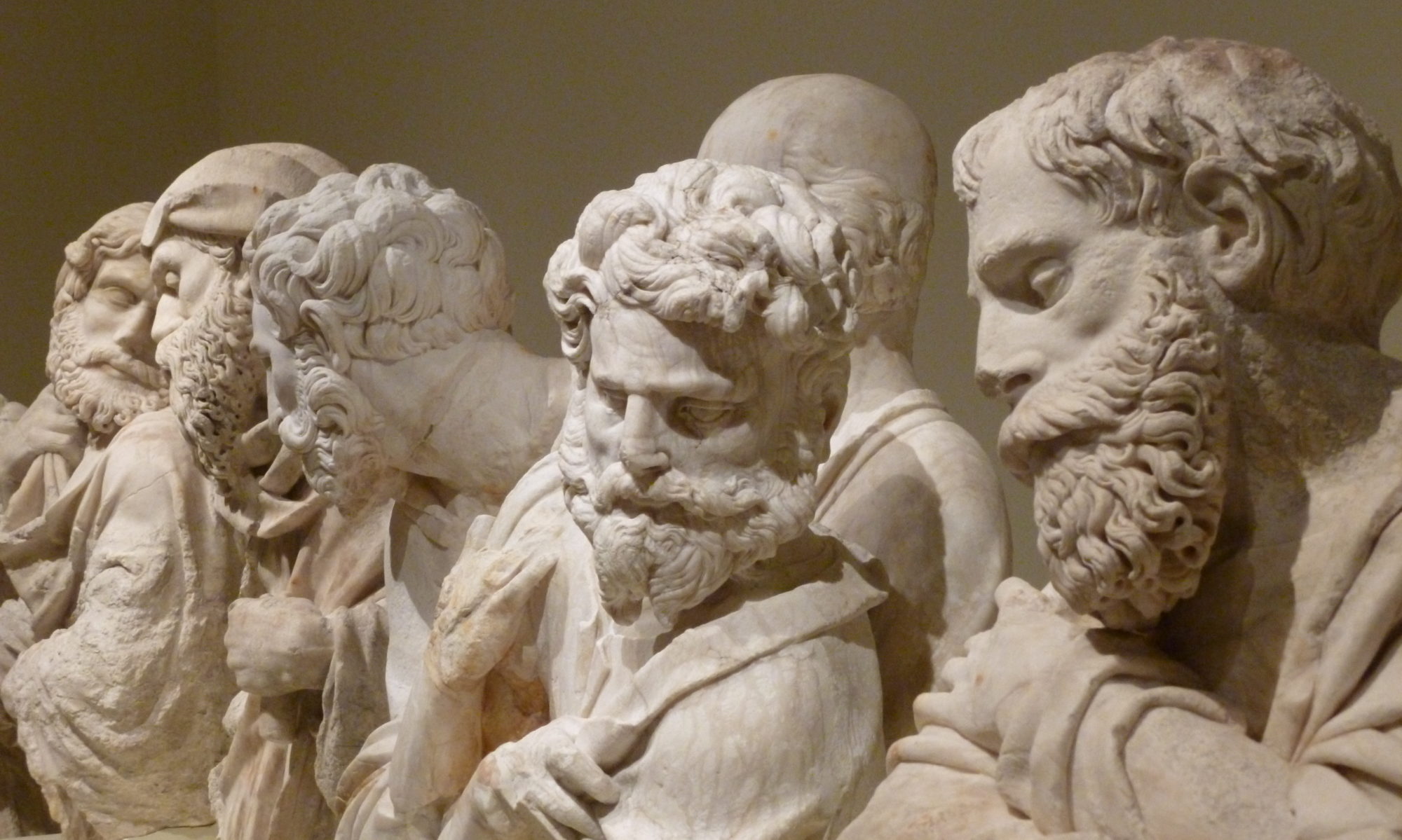
Acts of the Apostles 7:54-60
The ever-so functionally-named Public Broadcasting Service, better known as PBS, is currently showing an adaptation of Alexandre Dumas’ 1846 novel “The Count of Monte Cristo” on Masterpiece Theater. As you may recall, the plot considers questions of identity and accountability, the titular count wrongly imprisoned under another name.
If “the Count” was a fictional mystery, two real world mysteries have supposedly been solved in recent months. Well, maybe solved.
For the first, we travel back to New York City in the 1980’s, when graffiti evolved into what we now call “street art.” The most famous artists in that movement, Keith Haring and Jean-Michel Basquiat, started in the feral streets, and ended up critically acclaimed before their untimely deaths.
The heir to that tradition is undoubtedly England’s Banksy, who erected an unauthorized statue in Central London on Wednesday. Like Haring and Basquiat, Banksy has received critical acclaim and global recognition. Unlike his predecessors, Banksy has maintained the anonymity of the oft criminalized graffiti tradition. While starting in two dimensions, his guerrilla art quickly moved into three dimensions, even public performances. It has been displayed in major galleries and museums, has been monetized, both original works and licensed and unauthorized reproductions as prints, t-shirts, and tote bags. I have a reproduction of one work downstairs in the Pastor’s Study, another in my home.
Banksy began using his distinctive style, stenciling, at the turn of this century, and had his first show in a Los Angeles gallery in 2002. There has been speculation about his identity ever since. He has mounted massive multimedia works like the “DismaLand” bemusement park, had a month-long “residency” in New York City, produced pro-Palestinian public art in the West Bank. Much of his work satirizes the greedy, the powerful, and the violent.
Among those named as possibly Banksy was a member of the Trip Hop band Massive Attack. As early as 2008, the British newspaper “The Mail on Sunday” identified Banksy as another man, Robin Gunningham, born in 1974 near Bristol, England, where he attended the Cathedral School. Banksy’s representatives disputed this, though earlier this year, Reuter’s completed an extensive investigation, with newly uncovered evidence, and came to the same conclusion. So I guess now we know.
I’m not sure I needed to know Banksy’s real identity, at least not while he is still alive. Let it be a matter for historians. Though the work is still sometimes technically illegal, and I’m sure the targets of Banksy’s satire would have loved to see the artist behind bars. Those same targets now buy his art. It attracts what I think of as stupid money at auction, though it remains subversive. In 2018, one of his paintings sold at auction for more than $25 million dollars at Sotheby’s London, and immediately self-destructed. A shredder had been built into the frame.
Our second case of hidden identity has had an even greater economic impact, greater by orders of magnitude.
The first functional cryptocurrency was developed by someone using the alias Satoshi Nakamoto. His Bitcoin holdings are believed to be worth well north of $100 billion dollars, as reported by John Carreyrou in last Sunday’s New York Times. Carreyrou used evidence released during the trial of an imposter to unveil the true identity of Satoshi, Adam Back, a British cryptographer and leader in the Bitcoin movement.
Now, I have to be honest. I neither like nor trust cryptocurrency. It originated among a group of techno-libertarians, folks who did not want the government to be able to track transactions. But that meant all governments, both oppressive regimes and enlightened democracies. Not surprisingly, the technology first took off in the criminal underground, with sites like Silk Road, created on the Dark Web by Ross Ulbricht, using Bitcoin for illegal transactions including the sale of narcotics and child pornography, as well as the services of assassins. The federal government ultimately seized more than a billion dollars in Bitcoin, though Ross was later pardoned by our current president.
Today, cryptocurrency is still associated with the sort of hackers who terrorize hospitals and school districts, demanding their ransom in the technical equivalent of unmarked bills before they unlock critical data systems.
But even more than the ongoing use of Bitcoin and other cryptocurrencies for criminal activity, there is the simple fact that it is based on nothing, a Ponzi scheme, a bridge for sale in Brooklyn. There are no tangible assets like gold bullion attached, nor intangible assets like the “full faith and credit” of a government. And while there have been some successful prosecutions of scammers like Sam Bankman-Fried, the system is mostly anonymous and distributed, so much of the activity can never be traced.
When the bubble bursts, there will be no one to hold accountable.
Adam Back still denies being Satoshi, despite John Carreyrou’s fairly convincing reporting, though there is a late plot twist in the story. It turns out that Adam Back is now CEO of what is known as a cryptocurrency treasury, an enterprise in which he is partnered with the financial firm Cantor Fitzgerald crooks of a different order. As such, he is required by law to report any personal holdings that could create a conflict of interest. For example, $100 billion dollars in secret Bitcoins. Satoshi might yet be hoisted on his own petard.
Identity matters, from macro to micro, and not because of ancient superstitions about the magical power of a name. Identity is about accountability, is the foundation for covenant, relationships based on mutuality. In one of the Torah’s source texts, the Abrahamic people do not even know God’s name until it is required for covenant, revealed to Moses who will represent the Israelites before Yahweh.
Accountability, specifically avoiding accountability, is why the graffiti artist uses a tag instead of their name, is why cryptocurrency is the asset of choice for cyberterrorists, is why Klansmen wear hoods, and why Immigration and Customs Enforcement officers wear masks and no nametags.
Jesus offers forgiveness from the cross, a blanket pardon for the many-headed mob that conspired in his arrest, for the agents of empire that were murdering him, as is fitting, for he will seemingly be dead, and repentance and redemption are critical to the good news he offers.
Today, we heard of the martyrdom of Stephen from Luke’s Acts of the Apostles. He is falsely accused, brought before the Sanhedrin and condemned, the accusers required by law to cast the first stones, which they happily do. Again, we have a blanket pardon, for Stephen will not be around to offer forgiveness later. Everyone gets a chance to repent.
But neither of these instances is about avoiding accountability. God’s grace is wide, and we are called to forgive, seventy times seven times, like the Prodigal’s father, with extravagance that is good for us and for community, for grievance is a slow-acting poison. Our forgiveness is mandated in the gospels, selfish and selfless at the same time.
But the prophets promise consequence and reconciliation, as does Jesus, as does Paul in his counsel to the earliest churches on how to conduct themselves, how to make community. Even without the religious framework, the reality is that consequence is how we learn, hot stoves in childhood, and the adult equivalent of fake links in an email.
On the practical level, naming one another means a growing church, once it reaches a certain size, naturally becomes a group of over-lapping small churches, not cliques, but circles of care.
Call me by my name, and let me call you by yours, committed to a relationship in which we carry this amazing tradition into the future, changing lives, saving lives, inside this place made sacred by generations, and out there in the mission field, for every place outside of these doors is the mission field, from the meanest slum to the quietest forest glade. Ask them their names, then love them back to life.
Amen.
PRAYERS OF THE PEOPLE concluding with the Lord’s Prayer
Let us pray.
Holy Mystery,
tradition gives you many names,
and names to avoid your name.
You are infinite,
but we are finite,
as are our names,
and yet they still matter.
We’ve learned to say names as witness,
Trayvon Martin, Breonna Taylor, George Floyd,
and new categories of names,
Melissa and Mark Hortman and their Golden Retriever, Gilbert,
Renee Good and Alex Pretti,
the reporter Shireen Abu Akleh, murdered by Israeli forces,
the poet Victoria Amelina, a victim of Russian aggression,
but there are too many to name,
too many names we do not know,
dying in secret detention here,
slaughtered in Israel, Palestine, Iran, and Ukraine,
missing from the open air prisons
of displacement camps and reservations and slums.
We hold space for the names we do now know,
for they each were named,
each loved by someone.
We hold space for the ones we love,
some present, some absent,
all carried within us.
We call on the name of a rabbi,
Yeshua to his friends, Jesus to us,
and sometimes other titles,
the Human One,
the Anointed One.
We pray as he taught us,
saying:
Our Father …